

/fdata%2F0606912%2Favatar.png)
A Nether Picture from «Les Mohicans de Paris»
Treading the streets of Paris in the middle of the night to meet a beatiful lover, young Alexandre Dumas, «touriste noctambulant», carrying «ni canne, ni poignard, ni pistolets», passed always before a certain «porte voutée, à barreaux de fer», closed with an iron chain —and through the grate he could see a forest as mazy, entangled and thickset as those of India or the New World— more than a secluded park, a mysterious weald, stirring up an enchantment yielding to a sort of terror when, among the luxuriant leafage, at dusk, or under the pale silvery moonlight, the eye of an observer might discern the ruins of a crumbled mansion and a huge pit yawning among the weeds.
And then, in the silence, one had the impression to hear strange sounds like those coming from graveyards and wrecked towers and desolate manors at midnight.
That «fouillis étrange, sombre, indicible, de vieux arbres, de hautes herbes, de fougères, d’orties et de lierres rampants» would be enough to arouse any reader whose fantasy was imbued with macabre tales, even if no legend «de vols, d’assassinats, de rapts et de suicides qui planaient au-dessus de ce parc désolé comme une troupe d’oiseaux de nuit» was told.
A charcoal burner living in a sort of a cave guarded by a black dog opened the door from a long time closed and guided Dumas through the shrubs, bushes and creepers that «s’enroulaient, s’enlacaient, se tordaient, s’etreignaient étroitement sous le regard de la lune, dans ce grand hamac de verdure que formait la foret».
And then he conducted him around a deep chasm dropping down to the catacombs, where at least one man had vanished, until, at last, they came to the «escalier à perron de trois ou quatre marches» of the mansion, where everything was «défoncé, lézardé, en ruine», as in Anne Radcliffe’s novel, The Romance of the Forest …
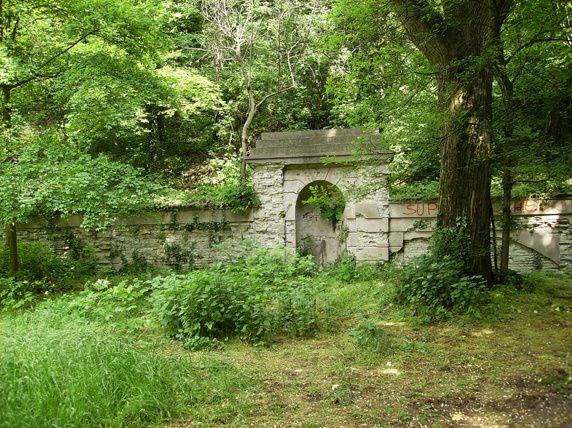
Ruins amidst a forest, where a gate to the netherworld opened in the heart of Paris, the capital of the Nineteenth century—an objet imaginaire as fathomless and reverberating as a divinatory sign—La Foret Vierge de la Rue d’Enfer …
And then, in the silence, one had the impression to hear strange sounds like those coming from graveyards and wrecked towers and desolate manors at midnight.
That «fouillis étrange, sombre, indicible, de vieux arbres, de hautes herbes, de fougères, d’orties et de lierres rampants» would be enough to arouse any reader whose fantasy was imbued with macabre tales, even if no legend «de vols, d’assassinats, de rapts et de suicides qui planaient au-dessus de ce parc désolé comme une troupe d’oiseaux de nuit» was told.
A charcoal burner living in a sort of a cave guarded by a black dog opened the door from a long time closed and guided Dumas through the shrubs, bushes and creepers that «s’enroulaient, s’enlacaient, se tordaient, s’etreignaient étroitement sous le regard de la lune, dans ce grand hamac de verdure que formait la foret».
And then he conducted him around a deep chasm dropping down to the catacombs, where at least one man had vanished, until, at last, they came to the «escalier à perron de trois ou quatre marches» of the mansion, where everything was «défoncé, lézardé, en ruine», as in Anne Radcliffe’s novel, The Romance of the Forest …
Ruins amidst a forest, where a gate to the netherworld opened in the heart of Paris, the capital of the Nineteenth century—an objet imaginaire as fathomless and reverberating as a divinatory sign—La Foret Vierge de la Rue d’Enfer …
Quotations are from
Alexandre Dumas,
Les Mohicans de Paris,
2 vols.,
Paris, Gallimard, 1998,
pp. 1551-1566.
Alexandre Dumas,
Les Mohicans de Paris,
2 vols.,
Paris, Gallimard, 1998,
pp. 1551-1566.